UPC List Insights That Clean Data and Drive Results
Better item data. Fewer errors. Stronger performance across every store.
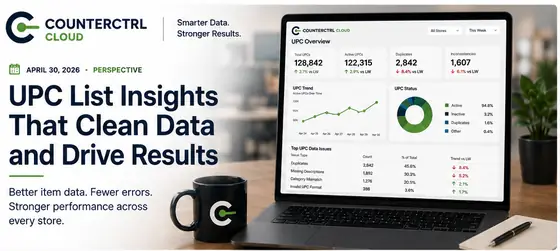
Every retailer's item file drifts. Not all at once, and rarely in a way anyone notices on a given Tuesday — but a duplicate created here, a description left blank there, a category assigned wrong during a busy week, and over a year the file quietly stops describing what's actually on the shelf.
The reason this matters isn't tidiness. It's that every number downstream inherits the problem. Category performance is only as good as the category assignments behind it. Movement reporting is only as good as the item records being counted. When a buyer looks at a department that appears soft, the honest first question is whether the department is soft or whether the item file says it is.
Four issues account for most of the drift, and all four are visible if someone goes looking: duplicate UPCs describing the same product twice, missing descriptions that make an item unreadable in any report, category mismatches that route sales to the wrong department, and invalid UPC formats that fall out of matching entirely.
The trouble is that nobody has time to go looking. Auditing an item file by hand across hundreds of thousands of records isn't realistic work for a merchandising team with a week to run, so the drift continues until something downstream looks wrong enough to investigate — usually months later, and usually starting from the wrong end.
UPC List is built to make that audit continuous instead of occasional. It monitors item data accuracy across the file, tracks movement at the item level, surfaces trends and gaps, and flags the specific records that need attention rather than reporting a health score nobody can act on. The output isn't a percentage. It's a list of items with something wrong, ordered by how much they matter.
The payoff shows up in every module that reads from the item file. Cleaner assignments make category reporting trustworthy. Complete descriptions make exports usable by the person who receives them. Consistent formats make movement comparisons hold up across weeks. None of that is glamorous work, and all of it compounds — which is exactly the kind of problem worth automating rather than scheduling.