Data Everywhere, Clarity Nowhere
Why more data hasn't made grocery operations easier to run — and what actually closes the gap.
Ten years ago, a regional grocer's entire annual data footprint would fit in a folder. Today the same chain produces more operational data in a single week — point of sale, DSD receiving, labor, ad performance, inventory movement — than that folder ever held.
By any reasonable measure, that should have made running stores easier. In practice, for most operators, it hasn't.
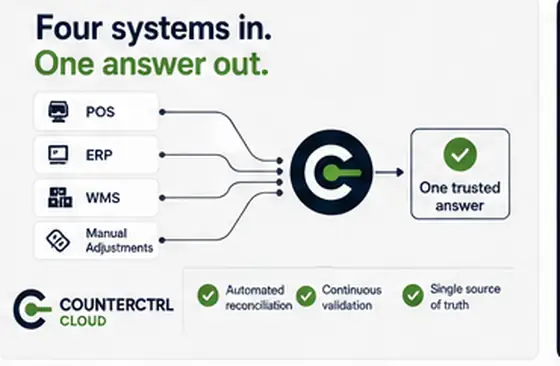
The reason is straightforward once you see it: none of these systems were built to talk to each other. POS data lives in one format, ERP in another, DSD receiving in a third. Each system is internally sound. None of them agree on what a "unit" or a "credit" means once you try to put two of them side by side. So the data piles up, technically available, practically unusable, because turning it into an answer means manually reconciling four systems every single time someone asks a question.
That's the poverty we mean when we say data everywhere, clarity nowhere. It isn't a shortage. It's a fragmentation problem, and fragmentation doesn't get solved by collecting more of it.
This is the specific gap CounterCtrl Cloud is built to close. Rather than asking an operator to reconcile POS, ERP, inventory, and DSD data by hand, CounterCtrl connects to those existing sources, normalizes them against a single set of definitions, and surfaces the result across five modules — Sales, Loss Prevention, Orders, Weekly Performance, and Coupons — so a number means the same thing no matter which screen you're looking at it from.
That's also why "Let Data Lead" is one of our founding principles rather than a marketing line. Data is only useful when it's trustworthy enough to act on without a second opinion. Getting there isn't about adding another dashboard on top of the pile — it's about giving every existing number one consistent home.
The next few posts walk through what that looks like in the store director's actual week: the Monday reconciliation, the questions that should be answerable before the doors open, and the reports that get built but never read.